Discovery; bacterial enzymes; its role in higher organsims;
nutritional aspects
Return to my main Science page
Return to My Research page
Return to Bad Science page


| HOME. | PQQ [Pyrroloquinoline Quinone] Discovery; bacterial enzymes; its role in higher organsims; nutritional aspects Return to my main Science page Return to My Research page Return to Bad Science page |
|
|
First described by Hauge, and by Anthony and Zatman in 1964 | |
| PQQ | Jens Hauge and Chris Anthony | Len Zatman |
| Early history of PQQ Function and structures of quinoprotein enzymes PQQ and higher organisms, especially man |
|||
| ............. | Early history of PQQ | ||
A prosthetic group is the part of an enzyme at the active site that is not the protein such as FAD (a riboflavin derivative) as in succinate dehdrogenase. PQQ was first described in 1964 as the prosthetic group of a soluble bacterial glucose dehydrogenase by Hauge (pdf) and as the prosthetic group of a bacterial methanol dehydrogenase by Anthony & Zatman (pdf). I was Len Zatmans's research student. Hauge did no further work on this but it occupied the rest of my carreer. |
 |
 |
|
| The Yamaguchi group: Matsushita ?Urakami? Ameyama and Adachi. This group have continued working on bacterial PQQ Enzymes. | References to this history Full details of all this science are elsewhere on this website together with links to PDFs: Click here |
||
| ............ |  |
| TOP | Participants in the 1988 Symposium in Delft |
| ........... | 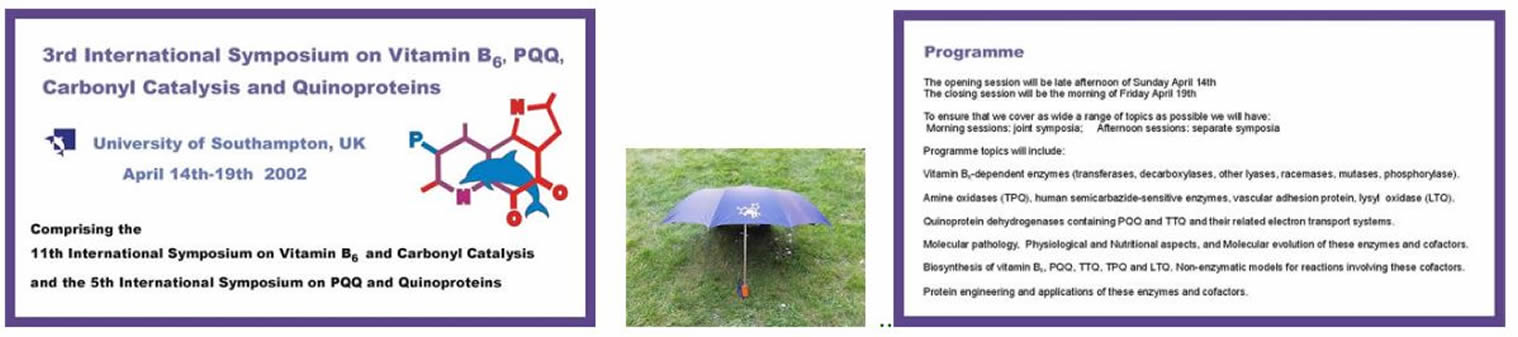 |
| The 5th PQQ Symposium by then merged with B6 Symposium. This fusion was bought about when it was shown that the prosthetic group of amine oxidases is also an orthoquinone (but not PQQ) |
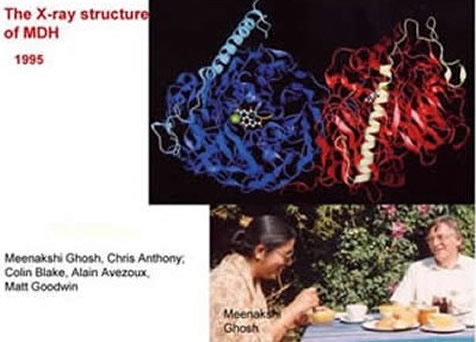
| TOP..... | Basic information on function and structures of quinoprotein enzymes Methanol dehydrogenase has a beta propeller structure and a small helical subunit. Memrane Gluscose dehydrogenase has the propeller structre plus a membrane domain that holds it in the membrane; the soluble glucose dehydrogenase has a rare 6-membered ring stucture. The alcohol dehydrogenase has the propeller structure plus a membrane domain and a haem-conataining domain. For full descriptions on this website of the PQQ-containing quinoproteins that are described below Click Here |
 |
||
| The Methanol dehydrogenase of methylotrophic bacteria. This oxidises methanol to formaldehyde during bacterial growth on methane or methanol.
It is a soluble enzyme, located in the periplasm. It has a 'propeller' structure with 8 beta sheets forming the propellers. It has a unique 8-membered ring
made by formation of a disulphide bridge between adjacent cystein residues in the polypetide chain.
There is a calcium ion bonded to PQQ in the active site. This structure was determed by my collaborator, Meenakshi Ghosh.
|
.jpg) |
.jpg) |
.jpg) |
|
| The membrane Glucose Dehydrogenase of enteric bacteria, acetic acid bacteria and pseudomonads. This quinoprotein is responsible for oxidation of glucose to gluconic acid in enteric bacteria, acetic acid bacteria and pseudomonads. It is anchored in the periplasmic membrane by the C-terminal domain made up of 5 membrane-spanning helices. the reaction is catalysed in the periplasm by the N-terminal domain; the amino acid sequence of this domain is sufficiently similar to that of methanol dehydrogenase (MDH) for its structure to be modelled using the MDH X-ray coordinates. | .jpg) |
 |
 |
|
| This was the work of my student Gyles Cozier | Structure based on the structure of methanol dehydrogenase. | The special disulphide ring of MDH is replaced with histidine | ||
| The glucose dehydrogenase of Acinetobacter calcoaceticus. This soluble ezyme is the enzyme from which. Hauge first isolated PQQ. It is unusuall in having only 6 propeller blades. | ||||
| The Alcohol Dehdrogenase (ADH) of acetic acid bacteria The ADH of Acetobacter aceti is a membrane enzyme responsible for the first step in oxidation of ethanol to acetic acid. The reaction occurs in the periplasm. It has a haem-containing domain and so is a quinohaemoprotein. The basic superbarrel structure and the active-site region are retained, indicating essentially similar mechanisms of action to methanol dehydrogenase. The amino acid sequence of this domain is sufficiently similar to that of methanol dehydrogenase (MDH) for its structure to be modelled using the MDH X-ray coordinates. |
.jpg) |
.jpg) |
 Gyles Cozier, who was responsible for all our modelling work |
|
| This was the work of my student Gyles Cozier | ||||
| NOTE: A Coprinopsis cinerea (fungus) pyranose dehydrogenase has recently been shown by Takeda et al (pdf) to have PQQ in its crystal structure. It has a 6-membered propeller structure like the soluble glucose dehdyrogenase from which ens Hauge first isolated PQQ | ||||
| TOP | ||||
| ........... | PQQ and higher organisms, especially man | For Later developments Click here |
| Early discussions | ||
No plants or animals have PQQ-containing enzymes. If they did so then it is likely that PQQ would be a vitamin; quinoproteins having PQQ would be analogous to flavoproteins having riboflavin (vitamin B2). A sort of exciting climax was reached in 2003 when nature announced a new redox cofactor for mice (PQQ). This was claimed to be the first new vitamin for 55 years! As a result Mitsubishi planned to invest millions of dollars in its production. When i heard of this I got Nature to publish the evidence against it and told Mitsubishi who accepted this and invited me to visit and to present the case at a symposium. They have continued with the develpment and sale of PQQ as a nutritional supplement. |
The original announcement by Mitsubishi about proposed develpment of PQQ as a vitamin
Mitsubishi Announcement: "On August 15, 2008, Mitsubishi Gas Chemical (MGC) announced that it had received official acceptance from the U.S. Food and Drug Administration (FDA) for its notification of coenzyme pyrroloquinoline quinone (PQQ) as a new dietary ingredient. Having received this acceptance, MGC will begin developing the U.S. market for PQQ as an initial step toward the commercialization of PQQ". Mitsubishi statement. NPI Center announcement: Highly-Anticipated PQQ (Pyrroloquinoline Quinone) Finally Commercialized As VitaPQQ(TM) From Maypro Industries: |
| .......... | Introduction Much of the work on the possible role(s) of PQQ in mammalian systems has been driven, or at least affected by the hope of getting evidence for its importance as a nutritional supplement. This has often been funded by companies with a financial interest in this. An important first contribution to this was one of the few contributions on this subect at the 1st International Symposium on PQQ and Quinoproteins in Delft in 1988. This described a positive effect of PQQ on growth of mice that were raised germ-free. This contribution was by Dr R. Rucker who has been perhaps the most important contributor to this subject ever since. These contributions are an attempt to provide information from good sources on the subject and to give some illustrations of misleading and exaggerated claims for PQQ in Mammalian systems. |
Reasons why this work is difficult to evaluate and interpret |
| TOP of Later | Potential Physiological Importance of Pyrroloquinoline Quinone By Robert Rucker et al. Alternative Medicine Review Volume 14, Number 3 2009 Abstract Pyrroloquinoline quinone (PQQ) is a novel biofactor for which a proposition can be made for physiological importance. PQQ was first recognized as an enzyme cofactor in bacteria. It has recently been tentatively identified as a component of interstellar dust. Thus, PQQ may have been present throughout early biological conception and evolution. PQQ is also a potent plant growth factor. Consequently, for animals and humans, there has been constant exposure to PQQ. In animals, PQQ is reported to participate in a range of biological functions with apparent survival benefits (e.g., improved neonatal growth and reproductive performance). There are also benefits from PQQ supplementation related to cognitive, immune, and antioxidant functions, as well as protection from cardiac and neurological ischemic events. Although PQQ is not currently viewed as a vitamin, its involvement in cell signaling pathways, particularly those important to mitochondriogenesis in experimental animal models, may eventually provide a rationale for defining PQQ as vital to life. For humans, such evidence suggests there may be similar parallels or benefits from improving PQQ status. (Altern Med Rev 2009;14(3):268-277) TOP |
Evaluation of PQQ as a nutritional supplement on Examine website This website provides a summary plus links to all its sources The aforementioned REDOX functions can alter protein function and signalling pathways, and while there is a lot of promising in vitro (outside of a living model) research on what it could do there are only a few promising results of PQQ supplementation, mostly related to either altering some signalling pathways or via its benefits to mitochondria (producing more of them and increasing their efficiency). It is a coenzyme in bacteria (so, to bacteria, this would be something like a B-vitamin) but this role does not appear to extend to humans. Since this does not extend to humans, the designation of PQQ as a vitamin compound has fallen through and it is only considered 'vitamin-like' at best. |
| TOP | TOP of Later | |
| The marketing of PQQ as a nutritional supplement PQQ is now marketed widely as a supplement with claims for a wide range of benefits. These claims are based on many nutritional investigations of PQQ and many studies on the effect of PQQ in isolated cells or tissues or whole experimental animals (mice and rats). The website claims of the marketers are often factually incorrect, wildly exaggerated and have many misunderstandings about biochemistry and physiology. For unbiased examination of supplements I strongly recommend the website Examine.com which is an "independent organization that presents un-biased research on supplements and nutrition. We currently have over 25000 references to scientific papers". This is an excellent website that examines claims for nutritional supplements and has a lengthy valuable discussion of PQQ. |
|
|
| TOP | ||
| ....TOP TOP of Later | Dreadful 'interpretation' of work suggesting PQQ has a function related to mitochondria I am writing this response at some length. The same responses are relevant to many PQQ sellers |
|
| PQQ and health. Response to an article in Life Extension Magazine Feb 2011 "Generate Fresh Mitochondria with PQQ. Scientists Discover the “Other CoQ10”. By Perry Marcone. Link to the original article The article quotes important work by Rucker and colleagues (see above) . In early studies, he showed that germ-free mice fed chemically-defined diets thrived more if provided with PQQ. He has been at the forefront of this sort of work and his paper relating PQQ to mitochondrial genesis is the one quoted by the article in Life Extension. We should note that this paper studied the effect of PQQ on isolated cell cultures of mouse liver cells. It requires a lot of extrapolation to conclude that PQQ may have an effect on mitochondrial generation in humans and even more to conclude that PQQ as a nutritional supplement will have an effect on ageing. But of course it may achieve this. It should be remembered that even if PQQ does have such effects this is not evidence that it has a ‘normal’ role in human physiology – it is possibly only acting as a ‘drug’. By its chemical nature it reacts powerfully with free radicals and so is an antioxidant. [Also note that there is no evidence that antioxidants in the diet have any benefit at all]. Some specific comments on the article: The paragraphs in italics are taken direct from the article, given in the order in which they appeared. 1. The most exciting revelation on PQQ emerged early in 2010, when researchers found it not only protected mitochondria from oxidative damage—it stimulated growth of fresh mitochondria! This refers to the Rucker study which used liver cells in tissue culture. This is important interesting work but it does not show that dietary supplementation with PQQ in animals/humans will lead to mitochondrial production. 2. Pre-clinical studies reveal that when deprived of dietary PQQ, animals exhibit stunted growth, compromised immunity, impaired reproductive capability, and most importantly, fewer mitochondria in their tissue. Rates of conception, the number of offspring, and survival rates in juvenile animals are also significantly reduced in the absence of PQQ. Introducing PQQ back into the diet reverses these effects, restoring systemic function while simultaneously increasing mitochondrial number and energetic efficiency. Note that to see these effects animals were often reared in extreme unnatural conditions [that is ok as this was the ‘cleanest’ way of showing effects]. Less effect is likely to be seen in animals if given PQQ in normal conditions. This is not surprising because there is a lot of PQQ in many foods, especially if bacteria have been involved in their production; for example vinegar has a lot of PQQ because it is made using bacteria that use a PQQ quinoprotein to oxidise alcohol to the active component of vinegar – acetic acid. |
3. As the primary engines of almost all bioenergy production, the mitochondria rank among the physiological structures most vulnerable to destruction from oxidative damage. PQQ’s formidable free radical–scavenging capacity furnishes the mitochondria with superior antioxidant protection. Firstly, we should not confuse mitochondrial activity with regeneration [the subject of Rucker’s paper]. Free radicals are inescapable occasional products of reaction with oxygen in the final step in energy production. We have evolved thus far by avoiding damage by these free radicals which are happily mopped up by mitochondrial enzymes with that sole purpose. There is no reason to think that “superior antioxidant protection” is needed. 4. At the core of this capacity is an extraordinary molecular stability. As a bioactive coenzyme, PQQ actively participates in the energy transfer within the mitochondria that supplies the body with most of its bioenergy (like CoQ10). This is completely untrue. Although it is true that coenzyme Q actively participates in energy transfer within mitochondria,PQQ has not been shown to have any function whatsoever in mitochondria. In bacteria it does have this function. During methanol oxidation for example the first step in energy production is catalysed by a PQQ containing enzyme that is so important that it constitutes 5-10% of the cell’s protein. PQQ enzymes have only been described in bacteria. 5. Unlike other antioxidant compounds, PQQ’s exceptional stability allows it to carry out thousands of these electron transfers without undergoing molecular breakdown. It has been proven especially effective in neutralizing the ubiquitous superoxide and hydroxyl radicals…….. A consistent finding in the scientific literature is that nutrients like PQQ provide more wide-ranging benefits than conventional antioxidants the general public relies on. As mentioned above, PQQ is a powerful antioxidant and it is stable and so of course will ‘neutralise’ free radicals. But there is no evidence that this ability of PQQ can be relevant to health. There is good evidence that antioxidants in the diet have no positive health benefit and may have slight negative effect. This is published as a Cochrane Review. 6. According to the most recent research, “PQQ is 30 to 5,000 times more efficient in sustaining redox cycling (mitochondrial energy production) . . . than other common [antioxidant compounds], e.g. ascorbic acid.” This is terrible. Redox cycling is a chemical process that was proposed as a way of measuring PQQ in a test tube. It not relevant in any way to “mitochondrial energy production”. 7. In a revolutionary advance, an essential coenzyme called pyrroloquinoline quinone or PQQ has been shown to induce mitochondrial biogenesis—the growth of new mitochondria in aging cells! PQQ is not an essential coenzyme in animals [see above]. The studies of PQQ and mitochondrial genesis that stimulated this article were on liver cells in lab culture, NOT ageing cells, or whole animals or humans. |
|
| TOP TOP of Later | ||
| TOP | A Recent review in Current Food Science | |
| TOP of Later | ||
Pyrroloquinoline Quinone (PQQ): Its impact on human health and potential benefits: PQQ: Human health impacts and benefitsYan et al. Curr Res Food Sci . 2024 Oct 22:9:100889. doi: 10.1016/j.crfs.2024.100889
AbstractPyrroloquinoline Quinone (PQQ) is a redox-active quinone molecule with significant implications for human health. Originally identified as a bacterial cofactor, PQQ has since been lauded for its diverse biological and therapeutic activities. 1. It serves as an essential cofactor for oxidative enzymes that are vital for mitochondrial function and ATP synthesis.
|
Healthline: a typical site for nutritional supplements. Website |
|
| WebMD is a prominent American online publisher that provides health, medical news, and well-being information. Founded in 1996, it has grown into one of the most widely visited consumer health websites in the world. | ||
| TOP | TOP of Later | |
| PQQ available on Amazon It is remarkable that these sell when there is no real evidence for any benefit (as with many 'nutritional supplements). A personal note: My first isolation of pure PQQ from methanol dehydrogenase took about 4 months: Growth of large amounts of bacteris; purifiation of methanol dehydrogenase; denaturation of my valuable pure enzyme: purification of the PQQ; unknown as PQQ then of course. Final product about 20 tiny red grains of the unknown prosthetic group. I was able to characterise it by its fluorescence. |
How it is produced 1. Bacterial Fermentation (Most Common)The vast majority of premium and clinically studied PQQ on the market—such as the widely recognized BioPQQ (sold as MGCPQQ in Europe)—is produced via a natural bacterial fermentation process.The Microorganism: Cultivators utilize specific strains of non-pathogenic, PQQ-producing bacteria, most notably Hyphomicrobium denitrificans. These soil bacteria naturally synthesize PQQ as a byproduct of their metabolic processes.The Process: The bacteria are grown in large, controlled fermentation vats supplied with precise nutrients. As they metabolize, they secrete PQQ.Purification: Once fermentation is complete, the mixture goes through rigorous filtration, separation, and purification steps. The final product is usually synthesized as a pyrroloquinoline quinone disodium salt, reaching a minimum purity of 99.0%. It is then dried into a reddish-brown, water-soluble powder. |
|
 |
||
| TOP | TOP of Later | |
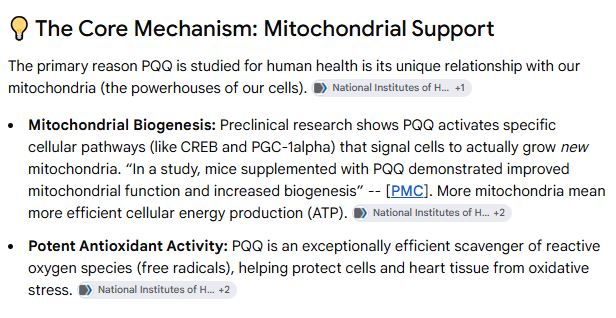
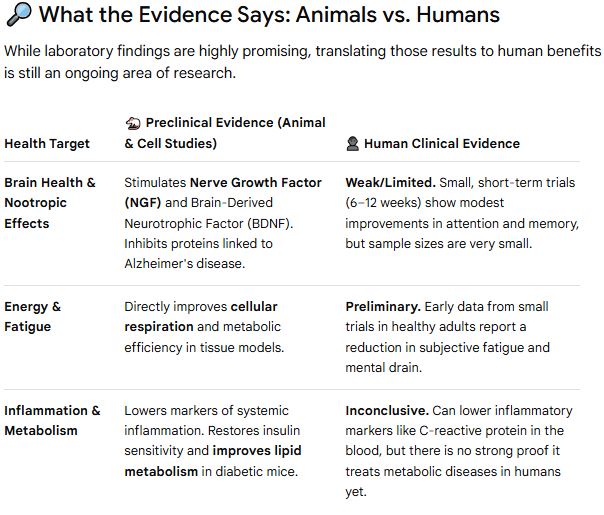
| TOP.. | Evidence for health benefits summarised on Google search | ||
 |
 |
 |
|
| ...TOP........ | My presentation to The International Interdisciplinary Conference on Vitamins, Coenzymes, and Biofactors 2005 Awaji, Osaka
For my photos of Japan from this visit Click Here |
Summary. The claim of Kasahara and Kato was based on sequence analysis of an enzyme, predicted to be involved in mouse lysine metabolism, using databases and search engines which inappropriately label beta propeller sequences as PQQ-binding sites. The ‘sites' wrongly identified by the databases do not represent PQQ-binding sites but represent the Beta -sheets that form the ‘blades' of the ‘propeller fold' which happens to be a feature of all PQQ-dependent dehydrogenases, whose main structure is a superbarrel made up of either six or eight ‘propeller blades'. What the evidence actually suggests is that their (predicted) enzyme is an interesting novel protein having an eight-bladed beta propeller structure; but there is no evidence that it is a PQQ-dependent dehydrogenase. There is also no evidence that this protein has any relevance to lysine metabolism. This material has been published the journal Nature (Felton and Anthony, 2005) (Download PDF). |
||||||||||||||||||||||||||||||||||
|
||||||||||||||||||||||||||||||||||||
| TOP | ||||||||||||||||||||||||||||||||||||

.jpg)
.jpg)
.jpg)
.jpg)
.jpg)
.jpg)
.jpg)
.jpg)
.jpg)
.jpg)
.jpg)
.jpg)
.jpg)
.jpg)